The Drama of Life and Death
The Armenian Genocide documented with hundreds of photos that clearly represent human tragedy, deprivation, humiliation and the raw struggle for life. This photo series is also a stern argument against Turkish denial.
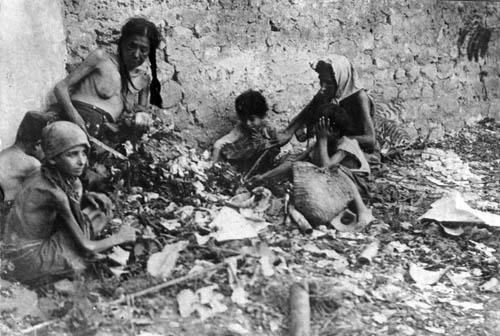
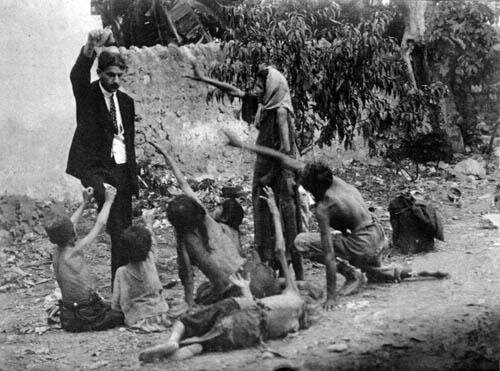
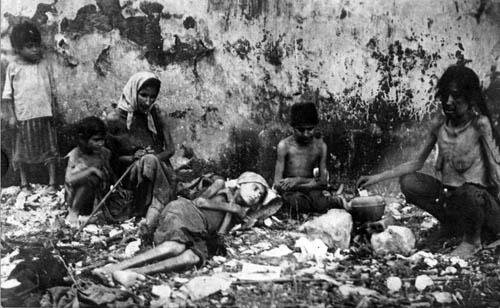
These four photos depicted in several editions, stand out in the series. Research conducted at the AGMI uncovered how these photos were taken by the same photographer, in the same place. They represent the last agonizing stages of Armenian deportees exiled in 1915. The originals of the photos are kept in the repository of the order of Mkhitarian monks on St. Lazarus Island in Venice, Italy and were first published in a volume “Chemin de la Croix. Quelque tableaux de dernier episode du grand drame” prepared for the Paris Peace Conference in 1919. They appeared in Venice after being confiscated from Turkish prisoners of war by an English officer in Aleppo, Syria and were taken to Egypt. From Egypt, they were brought to Mkhitarian order.
Six persons are depicted in these photos, four of them are children. The girl with headscarf stands out, as she is presented at all four photos. The story of her life and death is fixed in these photos. The little boy is also depicted in all four photos besides the girl. He is in the middle of the first photo.
The backgrounds of the first, second and forth photos are obviously the same, which allows us to state that the photos were taken at the same place- in the yard of a house. The plant has seen in the second and forth photos looks like a palm, therefore we suppose these photos were taken in Mesopotamia, modern day Iraq.
Six completely exhausted and half naked people are depicted in the first photo. The same six people are depicted in the second and third photos. Two women, the eldest of group, are sitting against the wall in the background. One of them dons a headscarf but the other is half-naked. Two of the children are sitting next to the woman with headscarf, while the other two are in front of the half-naked woman.
A man appears in the second photo. He is most probably a Turkish official, taunting the starving Armenian children with bread. Very evidently, the most exhausted person is the girl with headscarf, who from her prone position is raising her hand to the bread.
In the third photo, refugees sitting against a wall are cooking something in a pan. In this photo the girl with headscarf isn’t able to move and is exhausting the last minutes of her remaining life.
In the forth photo the girl with headscarf is lying in the stretcher. She must already be dead. The young girl and the boy carrying the stretcher appear in these photos for the first time. Taking into consideration the fact that they are dressed, we can suppose that they are a new group of Armenian deportees. A little boy with fez is lying behind the boy carrying the stretcher. Perhaps he is already dead. A boy in a shirt is sitting at the window in the last photo is the only one survived from the group of deported Armenians depicted in the first photo.